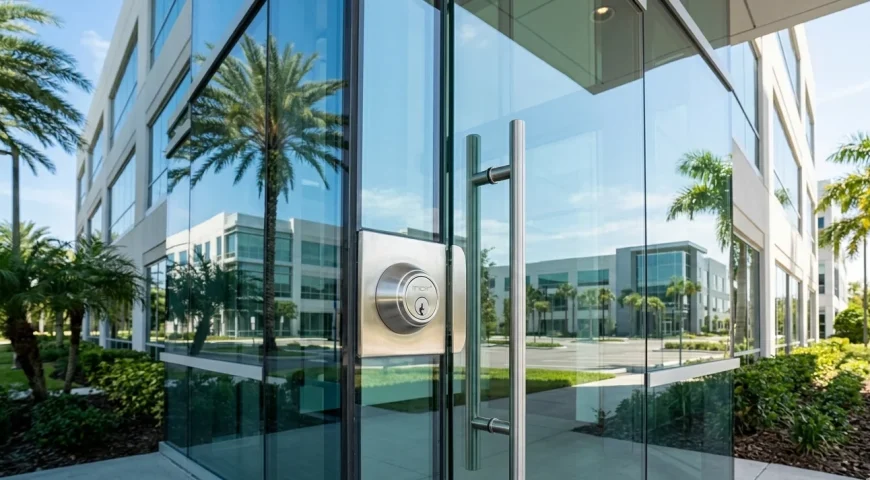
Your office door is the first line of defense against unauthorized entry. Therefore, choosing the best door hardware for office security is not just a purchase; it is an investment in your business continuity. In Central Florida, where commercial activity thrives from Orlando to Lake Mary, protecting your workspace demands hardware that withstands both daily wear and potential security threats.
This guide will walk you through the essential components of commercial door security. We will explore high-grade locks, advanced access systems, and smart technology solutions. Additionally, you will learn how to evaluate your current setup and when to call a professional for lock installation or upgrades. By the end, you will have a clear roadmap to fortify your office with hardware that matches your specific needs and budget.
Why Office Security Hardware Matters for Central Florida Businesses
Commercial properties in Central Florida face unique challenges. The humid climate can corrode inferior metals; meanwhile, high traffic in business districts accelerates hardware wear. Consequently, substandard locks and hinges fail prematurely, leaving your office vulnerable.
Moreover, modern threats extend beyond traditional break-ins. Internal security breaches, unauthorized access to sensitive areas, and lost keys all create liability risks. Because of this, the best door hardware for office security must address multiple threat vectors simultaneously. It should deter forced entry, control who enters where, and provide audit trails for accountability.
Furthermore, Florida building codes and insurance requirements often mandate specific security standards. According to the U.S. Small Business Administration, physical security measures significantly reduce theft and property damage risks for small businesses. Noncompliance can result in fines or denied claims after an incident. Thus, investing in certified, grade-appropriate hardware protects both your physical assets and your legal standing.
Understanding Commercial Door Hardware Grades
Not all locks are created equal. The American National Standards Institute (ANSI) and the Builders Hardware Manufacturers Association (BHMA) grade commercial hardware on durability and security. Understanding these grades helps you select the best door hardware for office security without overspending on unnecessary features.
Grade 1 Hardware: Maximum Protection
Grade 1 locks are the heavyweights of commercial security. They withstand over one million open-and-close cycles and resist significant force. Because of their robust construction, these locks are ideal for main entry doors, server rooms, and any area requiring maximum protection.
In addition, Grade 1 deadbolts and lever sets often include reinforced strike plates and anti-pick pins. These features make forced entry extremely difficult. For businesses in high-traffic Orlando corridors or near public spaces, Grade 1 hardware provides essential peace of mind.
Grade 2 Hardware: Balanced Security
Grade 2 locks offer solid protection for interior office doors and less critical access points. They endure around 800,000 cycles and meet most commercial insurance requirements. Furthermore, they cost less than Grade 1 options while still providing reliable defense.
Many Central Florida offices use Grade 2 hardware for conference rooms, storage closets, and departmental dividers. This tier balances budget constraints with genuine security value. However, avoid using Grade 2 locks on primary exterior doors where exposure to weather and tampering is highest.
Grade 3 Hardware: Residential Use Only
Grade 3 locks belong in homes, not offices. They handle roughly 200,000 cycles and lack the reinforced components needed for commercial environments. Using Grade 3 hardware in your office creates a significant security gap. Therefore, always verify the ANSI/BHMA grade before purchasing any lock for business use.
Essential Components of the Best Door Hardware for Office Security
A secure office door relies on multiple integrated components. Each piece plays a specific role in the overall defense system. Below, we break down the critical elements you should evaluate.
Commercial Deadbolts and Locksets
Deadbolts remain the cornerstone of door security. A single-cylinder deadbolt operates with a key outside and a thumb turn inside. Conversely, a double-cylinder deadbolt requires a key on both sides. The latter prevents intruders from breaking nearby glass and reaching inside to unlock the door.
For offices, we recommend Grade 1 commercial deadbolts with hardened steel bolts. These resist sawing, prying, and hammering. Additionally, consider deadbolt installation by professionals to ensure proper alignment with the door frame. A poorly installed deadbolt, regardless of quality, fails under moderate force.
Heavy-Duty Door Hinges and Frames
Security hardware is only as strong as what surrounds it. Heavy-duty hinges prevent doors from being lifted off their frames. Similarly, reinforced steel frames distribute force evenly during attempted breaches.
In Central Florida, stainless steel or brass hinges resist corrosion from humidity. Moreover, security studs or non-removable pins prevent hinge-pin attacks. Because attackers often target the weakest point, neglecting hinges undermines even the best door hardware for office security.
Strike Plates and Door Reinforcers
The strike plate is the metal fixture where the bolt enters the door frame. Standard strike plates use short screws that barely penetrate the frame stud. In contrast, high-security strike plates use three-inch screws that anchor deep into the wall framing.
Door reinforcers, or wrap-around plates, strengthen the area around the lock and handle. These metal sleeves prevent splitting and cracking during kick-in attempts. Consequently, pairing quality locks with reinforced strike plates dramatically improves your door’s resistance to forced entry.
Panic Bars and Exit Devices
Florida fire codes require specific exit hardware for commercial buildings. Panic bars allow quick egress during emergencies while maintaining security from the outside. Modern panic bars integrate with alarm systems to alert management when used.
Furthermore, some exit devices include delayed egress features. These sound an alarm for fifteen to thirty seconds before unlocking, deterring unauthorized use while still meeting safety standards. The National Fire Protection Association publishes the Life Safety Code that governs these requirements in commercial buildings. Because compliance and security intersect here, professional lock installation ensures your panic hardware meets both OSHA and local fire marshal requirements.
Advanced Access Control for Modern Offices
Physical keys are no longer the only option, nor always the best. Advanced access control systems offer superior management capabilities for multi-user office environments. These solutions eliminate rekeying costs and provide real-time monitoring.
Keypad and Card Reader Systems
Keypad entry systems require a PIN code for access. They work well for areas with limited users where code changes are manageable. However, shared codes create accountability gaps. For this reason, card reader systems often prove superior for larger offices.
Proximity cards or RFID badges assign unique credentials to each employee. When someone leaves the company, you simply deactivate their card. This eliminates the expense and security risk of rekeying physical locks. Additionally, audit logs show exactly who entered which door and when.
Biometric Access Solutions
Biometric readers use fingerprints, retinal scans, or facial recognition to verify identity. These systems offer the highest level of credential security because biometric data cannot be lost, stolen, or shared. However, they require higher initial investment and careful privacy compliance.
For Central Florida offices handling sensitive data, such as legal or medical practices, biometric access provides essential protection. It ensures that only specifically authorized personnel reach restricted zones. To explore integrated options, consider access control systems tailored to your facility layout.
Master Key Systems for Tiered Security
A master key system creates hierarchical access levels. The office manager might carry a master key opening all doors, while department heads carry sub-master keys for their areas only. Individual employees receive keys for their specific workspaces.
This structure reduces the number of keys in circulation while maintaining strict boundaries. Furthermore, it simplifies key management as your business grows. Nearmekey specializes in designing and implementing master key systems that scale with Central Florida businesses of any size.
Smart Locks and Connected Security Hardware
The Internet of Things has revolutionized office security. Smart locks connect to your network, enabling remote management and automation. These features are especially valuable for businesses with multiple locations or flexible work schedules.
Remote Lock Management
Smart locks allow administrators to lock or unlock doors from anywhere using a smartphone or computer. This capability proves invaluable when an employee forgets their key or when you need to grant temporary access to a contractor. Additionally, you receive instant notifications of lock activity.
However, network-connected devices require robust cybersecurity. The Cybersecurity and Infrastructure Security Agency recommends regular firmware updates and strong network segmentation for all IoT security devices. Weak passwords or outdated firmware can expose your office to digital attacks. Therefore, choose smart locks from reputable manufacturers that provide regular security updates. Professional smart lock installation ensures both physical and digital security protocols are properly configured.
Integration with Alarm and Camera Systems
The best door hardware for office security does not operate in isolation. Smart locks integrate with alarm systems, surveillance cameras, and building automation platforms. When a door unlocks after hours, the system can trigger cameras to record and send alerts to security personnel.
This interconnected approach creates a comprehensive security ecosystem. It transforms individual hardware pieces into a unified defense strategy. For Central Florida businesses concerned about after-hours protection, integrated smart systems offer unmatched situational awareness.
Battery Backup and Fail-Safe Options
Power outages are common during Florida’s storm season. Smart locks must include reliable battery backup to maintain function during electrical failures. Alternatively, fail-secure models remain locked when power drops, while fail-safe models unlock to allow egress.
Choosing between these options depends on your specific security priorities and fire code requirements. A professional commercial locksmith can assess your building layout and recommend the appropriate configuration for each door.
Evaluating Your Current Office Door Security
Before purchasing new hardware, conduct a thorough assessment of your existing setup. Many offices have mixed hardware ages and grades, creating inconsistent protection levels. A systematic evaluation reveals these gaps.
Conducting a Door-by-Door Audit
Walk through your facility and examine each door. Note the lock grade, condition of hinges, strike plate screw length, and frame integrity. Also, check whether any doors have been modified with aftermarket hardware that compromises original security ratings.
Document which doors have standalone locks versus integrated access control. Identify areas where multiple employees share keys or where lost keys have not prompted rekeying. This audit creates a baseline for prioritizing upgrades.
Identifying Vulnerability Points
Pay special attention to secondary doors. Loading docks, side entrances, and utility access points often receive less security investment than main lobbies. Yet attackers frequently target these overlooked areas. Similarly, interior doors protecting financial records or IT equipment deserve high-security treatment.
Windows adjacent to door locks present another common vulnerability. If breaking a window allows an intruder to reach the interior lock, your hardware choice must account for this exposure. Double-cylinder deadbolts or window security film address this risk effectively.
Scheduling Professional Security Consultations
While self-assessment is valuable, professional insight catches details untrained eyes miss. A licensed locksmith evaluates door swing direction, frame material, and local code requirements. They also recommend hardware brands with proven track records in Florida’s climate.
Nearmekey provides comprehensive security evaluations for businesses throughout Central Florida. Our technicians understand the specific challenges facing offices in Orlando, Winter Park, Lake Mary, and surrounding communities. We translate your audit findings into a prioritized action plan with clear timelines and options.
Maintenance Tips for Long-Lasting Door Hardware
Even the best door hardware for office security degrades without proper care. Regular maintenance extends equipment life and prevents unexpected failures. Establish a maintenance schedule to protect your investment.
Lubrication and Cleaning
Locks should be lubricated annually with graphite or Teflon-based products. Avoid oil-based lubricants that attract dust and gum up internal mechanisms. Additionally, clean exterior hardware with mild soap to remove grime that can corrode finishes.
In coastal Central Florida areas, salt air accelerates metal corrosion. For offices near the coast, increase inspection frequency and consider marine-grade hardware finishes. Early detection of rust or pitting prevents catastrophic lock failure.
Tightening Hardware and Adjusting Doors
Over time, screws loosen and doors sag. This misalignment causes latches to miss strike plates and locks to bind. Quarterly inspections should include tightening hinge screws and checking door alignment. If a door rubs against the frame, address the underlying cause rather than forcing the lock to compensate.
Rekeying After Personnel Changes
Whenever an employee with key access leaves, rekey affected locks. This policy should be automatic and documented. For offices using traditional keys, lock rekeying is faster and more economical than full replacement. Alternatively, upgrading to electronic access control eliminates rekeying entirely.
Frequently Asked Questions About the Best Door Hardware for Office Security
Business owners often have specific questions when upgrading office security. Below, we address common concerns to help you make informed decisions.
What is the most secure type of lock for an office door?
The most secure option depends on your specific threat model and usage patterns. Generally, Grade 1 commercial deadbolts with reinforced strike plates provide excellent physical security. However, for offices requiring audit trails and user management, biometric or card reader access control systems offer superior accountability. Therefore, the best door hardware for office security often combines multiple technologies rather than relying on a single device.
How often should commercial door locks be replaced?
Quality Grade 1 locks can last many years with proper maintenance. However, you should replace locks when they show signs of wear, after a security incident, or when they no longer meet current standards. Additionally, if your office has experienced multiple rekeys, internal mechanisms may become sloppy. In such cases, replacement restores full security integrity.
Can I install high-security locks myself, or do I need a professional?
While DIY installation is possible for simple residential locks, commercial-grade hardware demands professional expertise. Proper alignment, strike plate reinforcement, and code compliance require specialized tools and knowledge. Improper installation voids warranties and creates security gaps. Consequently, we strongly recommend professional lock installation for all commercial applications.
What is the difference between rekeying and replacing a lock?
Rekeying changes the internal pin configuration so old keys no longer work. The lock hardware itself remains in place. This process is cost-effective when the existing lock is in good condition. Conversely, replacing a lock installs entirely new hardware. Choose replacement when upgrading to higher grades, switching to smart locks, or when existing locks are damaged. Both services are available through Nearmekey’s lock repair and rekeying programs.
Are smart locks reliable enough for business use?
Modern commercial smart locks from established manufacturers are highly reliable. They offer battery backups, encrypted communications, and rugged construction suitable for business environments. Nevertheless, reliability depends on proper installation, network security, and regular firmware updates. For maximum dependability, pair smart locks with traditional high-security hardware as part of a layered defense.
How much does it typically cost to upgrade office door security?
Costs vary based on the number of doors, hardware grades, and technology level. Basic Grade 1 lock upgrades for a small office represent a modest investment. In contrast, full access control systems with smart integration require larger budgets. Because every office differs, Nearmekey provides customized quotes following a free on-site evaluation. We offer tiered solutions to match various budgets without compromising core security needs.
Do I need different hardware for interior versus exterior office doors?
Absolutely. Exterior doors face weather exposure, forced entry attempts, and higher traffic. They require Grade 1 locks, weatherproof finishes, and reinforced frames. Interior doors, while needing less environmental protection, still require appropriate security for their protected contents. Server rooms and executive offices merit Grade 1 or access control hardware, whereas general storage may use Grade 2. Matching hardware to location function optimizes both security and expenditure.
Conclusion: Secure Your Central Florida Office with Confidence
Selecting the best door hardware for office security requires careful analysis of your environment, threats, and operational needs. From Grade 1 deadbolts to integrated smart access systems, today’s commercial hardware offers solutions for every scenario. The key lies in choosing components that work together as a cohesive system rather than treating each door as an isolated problem.
In Central Florida’s dynamic business landscape, your office security directly impacts your ability to operate without disruption. Proper hardware deters criminals, controls internal access, and ensures compliance with safety regulations. Moreover, professional installation and maintenance protect your investment over the long term.
Nearmekey stands ready to assist Central Florida businesses with expert guidance and certified locksmith services. Whether you need a single high-security lock installation or a comprehensive access control system, our team delivers results that meet your specific requirements.
Do not wait for a security incident to reveal weaknesses in your current setup. Instead, take proactive steps today. Contact Nearmekey to schedule your free office security evaluation. Together, we will identify the best door hardware for office security tailored to your Central Florida business, ensuring protection that lasts.